Showing posts with label review. Show all posts

Sunday, December 9, 2012

THE VIEW by Rust Co-Operative

My first 'job' out of varsity. The response has been incredible and the process: even better.

We've had some fantastic reviews so far. I'll keep adding them to this post.

Expressing a View
Biz Lounge news
Expressing a View

By: Daniel Dercksen6 Dec 2012 12:44Submit a commentBizLikeThe View, which is now on at UCT's Intimate Theatre, can only be described as a cerebral orgasm of thought, ideas and expression.This fundamentally radical new play from Philip Rademeyer, who gave us the vexing Lie, is an emotionally charged explosion of awareness. It effectively examines humanity and explores humaneness, turning points of view upside down and inside out with astounding wit and dark humour, profound intelligent introspection and absurd truth.
Inspired by an American pastor's recent comments that gays and lesbians should be contained in an isolated enclosure and ultimately killed off, The View's simplistic setting features a young man imprisoned in a cell, looking down at a ruined Earth and dreaming of being rescued. Through a series of conversations between the boy and family members, historical figures and characters from his imagination, the play illuminates the boy's life and relationships, and also reveals the reason for his incarceration.

Magnificent performances
If there is one reason to see this important work of art, it's for Gideon Lombard and Ella Gabriel's magnificent performances. Lombard has flexed his acting muscle with extraordinary performances in ... miskien and Special Thanks To Guests From Afar, and, with The View, his well-honed instinctive sensibility and natural talent brings heartbreaking characters to vibrant life with heartfelt passion. Lombard is mesmerising, his performance filled with a charming honesty that is sincere.
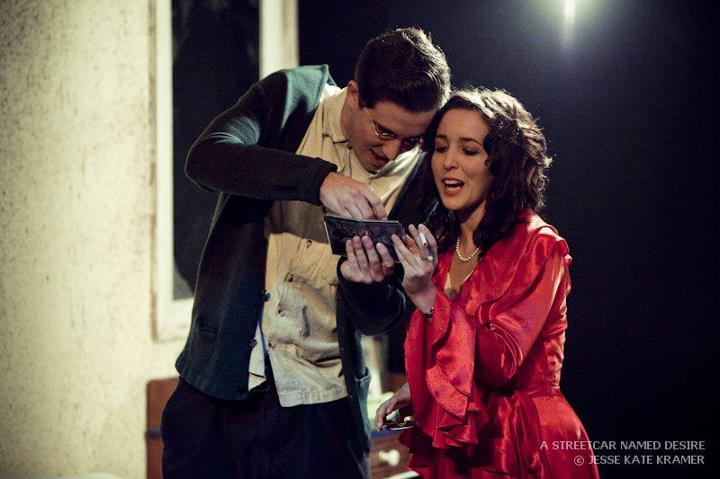
Equally brilliant is Ella Gabriel, who blew audiences away with her remarkable performance in UCT's A Streetcar Named Desire, delivering a sensational performance as the many characters who oppose and question the tormented young man's views. Gabriel's gift is undeniable; The View gives audiences a unique opportunity to witness the vast range of her special talent.

Incredibly visceral visual sense
Rademeyer's exceptional skill as writer is only equalled by his incredibly visceral visual sense, filled with delicate detail and controlled excellence. He allows us to listen, to really listen, digest and absorb his richly textured and multi-layered text. It's also an incredibly funny and poignant dissection of the eternal rivalry between what society deems normal and anomalous; a dramatic conflict between heterosexual bliss and procreation and homosexual evil; the universal faces of love in all its extremes, and life placed under an astute microscope.
The synergy and crackling chemistry between Lombard and Gabriel is exceptional, as well as the unique symbiosis between words and performance. The View is what live theatre is all about and how live theatre can challenge its audience intimately and personally.

Senseless jabbering and meaningless and worn-out words
There is defence in its offence, and shows how senseless jabbering and meaningless and worn-out words can suffocate and poison interpretation and communication. Recollections, judgment and thoughts are explored in their extreme and stripped naked and raw. No matter how set your view is, dare to challenge who you are and what you think with The View.

We need brainy plays like The View to stimulate the intellect and allow us a unique opportunity to look at the world differently and respect other people's views. "Humans, people, are the problem," states The View, and, for once, I have to agree. Also, "People are not the problem," is its defence. "They are too timid. The darkness beckons and they run away." When madness has destroyed the fabric of our humaneness, regret always comes too late and memories become our eternal prison.

The View is an intimate journey into what is wrong with the world and an important exploration of what needs to be done to improve the world and the quality of our lives.
The View is only on for one week so do whatever you have to in order to experience this exceptional proudly South African production. 

Read more about The View at www.writingstudio.co.za/page1746.html
The View runs at the Intimate Theatre until 14 December at 8pm (no performance Monday, 10 December). Tickets are R70/R50. To book, emailrustcooperative@gmail.com or call +27 (0)82 410 6996.

And:


http://www.mondaymissile.co.za/rvwtheview.html#.UMSHdI429SU
A sermon, preached by a certain Pastor Charles L. Worley of Providence Road Baptist Church in Maiden, North Carolina, captured on a video camera and posted on YouTube, went viral:  It's been viewed more than  282,500 times and has been covered in blogs, in newspapers and by TV stations around America. The New York Daily News and the Huffington Post counted it as one of the most trafficked stories of the day.  In his sermon the good pastor suggested that gays and lesbians be incarcerated in huge enclosures surrounded by electric fences... "And have that fence electrified 'til they can't get out," he says.  "Feed 'em and you know what, in a few years, they'll die out.  Do you know why? They can't reproduce”. The most frightening part of this pastor’s tirade is that his statements do not exist in isolation. This type of hate speech is heard around the world on a daily basis. There are governments taking steps to eradicate homosexuality and liberal thinking from their populations.

In Philip Rademeyer’s new play The View, a young man sits alone in a hermetically sealed pod at an undisclosed location, looking down at a ruined earth and dreaming of being rescued.  A gatekeeper or jailer arrives with his final request;  a video containing interviews with various people from his life. From his hermetically sealed pod, the boy reviews the people and influencers from his life. It unfolds as a type of docudrama, the characters (and there are many) each in turn relate their insights, opinions and feelings about the young man. It’s an apocalyptic scenario in which homosexuals and other dissidents are subjected to a Stalinist isolation.  Bigotry, hate and ignorance mix with love, compassion and misunderstanding in this powerful piece of theatre. Written as a two-hander, this play, staged by Rust Co-Operative, is set to be the talking point of Cape Town theatrical circles for quite some time.  It is beyond poignant; it’s hard hitting and very real narrative strikes at the very core.  Gideon Lombard as the young man delivers a deep and very dark perspective on gay life.  At times hopeful of liberation and at others resigned to his fate, his existence is a metaphor for those in society who examine and question their perceived isolation from society and it’s norms.  A strong and pivotal performance from Lombard sets an anchor for perhaps the most striking facet of the play. The video characters described earlier are all played by Ella Gabriel. In a tour de force she characterises everything from the driver who brought the young man to this place of isolation, to his parent’s struggling to accept his homosexuality and his current disposition.  She moves seamlessly from one character to the next with only the aid of a few simple props.  The audience riveted to each monologue in turn, these two actors charging us to examine our most deeply held opinions and beliefs. Hardly daring to breathe, I await each new development in turn.  


An eerie soundtrack accompanies the play.  Set design by Penelope Youngleson is stark and simple. Lighting, sound and set are perfectly fitting for this apocalyptic scenario.  As I leave the confines of the Intimate Theatre, I am excited and disquieted by what I have just seen.  Chatting briefly to friends and colleagues we can all agree on one thing, this is a must see. Don’t miss it! 


Postscript: The View is fast becoming a talking point and the word is spreading fast. Hopefully another stage will beckon before too long.  

And (I'll add the translation once it's done):


Poëtiese teks oor hoop en verlies tref sekuur

2012-12-10 01:48
Charles Worley het geskok, maar sy gewraakte opmerking het toe tog positief vrugte gedra.
Vroeër vanjaar het Worley gesê gays en lesbiërs moet in konsentrasiekampe gesit word waar hulle uiteindelik kan uitsterf sonder om voort te plant.
Kyk ’n mens na wat byvoorbeeld in Uganda aan die gebeur is, en selfs net na korrektiewe verkragting op ons voorstoep, sien jy dat baie ander sy sentiment deel.
Nou by die positiewe: Philip Rademeyer het die stelling gevat en op sy kop gedraai. Hy bied aan ’n jong man die kans om diep in sy siel te gaan delf en met sensitiwiteit oor sy lewe en verhoudings te praat. Hy praat met sy familie, soms praat hy sommer net.
Gideon Lombard sit in die kollig. Aan die een kant is dit ’n gevangenis. Eers later besef ’n mens wat die ‘‘misdaad’’ is waarvoor hy moet boet.
Vir die gehoor is die ruimte aan die ander kant amper ’n beskermende borrel waarin hy kan praat en praat en praat, en sit en sit, en is en is.
Min akteurs kan dit regkry om ’n marathon binne ’n beperkte ruimte hardloop. Lombard kry dit reg om dit op een kolletjie, op een ongemaklike stoeltjie, reg te kry.
Die indruk word gewek dat hy neerkyk op ’n plek van verwoesting. Sy laaste wens is om ’n video te kry waarop onderhoude is met verskillende mense wat ’n indruk op hom gemaak het.
Gabriel glip moeiteloos in verskeie karakters se vel. Sy is onder meer hekwag, bestuurder, engel, gewese geliefde, die kind wat hy nooit sal hê nie, suster, pa en ma.
Elkeen is ’n perfekte klein kamee wat met min woorde eintlik so baie sê. Die pa weet dat sy seun iewers vanuit die sterre op hom afkyk.
Die ma is die een wat jou die meeste aangryp. In haar klein wêreld waar sy nog haar plastiekhandskoene dra, vir waarskynlik skottelgoed was, en haar klein figuur in ’n soortgelyke ligkol, slaan sy jou vierkantig in die midderif.
Die teks hanteer verlies, hartseer, herinneringe en hoop. Dis diggeweef, dis digterlik, dis briljant.
Gemeet aan vorige werk wat die klein geselskap Rust Co-operative al gedoen het, het mens iets uniek verwag. Dat jy die teater snikkend en totaal oorweldig gaan verlaat, kon mens egter nie voorsien nie.
- Die Burger


Wednesday, May 23, 2012

A Streetcar Named Desire - Postmortem.

For the past few months of my life, I have been completely engulfed in another woman's life. Quitting bad habits like biting my nails and drinking three litres of Coke a day, learning how to apply red lipstick, gymming, yoga-ing, dressing more feminine, eating like a bird, and drinking quite a lot of whiskey to feel a little more like Blanche DuBois has been one of the most amazing experiences of my life. Not many pipskqueak 4th-year level actors get the opportunity to play such a beautiful, demanding role. I feel very privileged. And quite depressed now that it's over. But that'll pass. I hope. But for now I want to rest in the wake of the best fun I've ever had.

This was our review in the Cape Times, May 14 2012, by Tracey Saunders. 

Another review we had was written by Daniel Dercksen of The Writers' Studio:


A Streetcar Named Desire
By: Daniel Dercksen11 May 2012 15:22Submit a commentBizLike

A Streetcar Named Desire is stopping over at the Arena Theatre at the UCT campus in Orange Street until 19 May and you cannot miss this rare opportunity of seeing Tennessee Williams' classic masterwork in action!

Under the inspired and caring direction of Luke Ellenbogen, Williams' tragic comedy bursts to life with such energy, verve and vivacity that it's hard to believe that you are actually watching a production in Cape Town with third- and fourth-year students of UCT's drama production raising the bar for the excellence of theatre and vibrant new talent. These are the actors of tomorrow and, judging by the passionate performances by the ensemble of energetic performers, there is something to look forward to in the near future. 
It's encouraging and inspirational to find UCT presenting a play of this magnitude, truly putting the actors through a blender that delivers a potent energy drink consisting of emotional and physical lustre.
Widely considered a landmark play, A Streetcar Named Desire deals with a culture clash between two characters: Blanche DuBois, a relic of the Old South; and Stanley Kowalski, a rising member of the industrial, urban working class. 


Alcoholism and delusions of grandeur
The play presents Blanche DuBois, a fading-but-still-attractive Southern belle whose pretensions to virtue and culture only thinly mask alcoholism and delusions of grandeur. Her poise is an illusion that she presents to shield others (but most of all, herself) from her reality, and an attempt to make herself still attractive to new male suitors. Blanche arrives at the apartment of her sister Stella Kowalski in the French Quarter of New Orleans, on Elysian Fields Avenue; the local transportation she takes to arrive there includes a streetcar route named "Desire". The steamy, urban ambiance is a shock to Blanche's nerves. Blanche is welcomed with some trepidation by Stella, who fears the reaction of her husband Stanley, an American immigrant.
The play deals with the conflict between two ways of life: the old civilisation vested in Blanche is demonstrably decadent; in sexual terms the old world is associated with febrile femininity and the new world with a charismatic, but brutal, masculinity. 


A porcelain doll wrapped in barbed wire
A delicate flower, a porcelain doll wrapped in barbed wire, Ella Gabriel delivers a feisty and fragile tragic heroine who falls from grace, a woman who seeks refuge from unhappiness in the pursuit of pleasure, however destructive to herself and others. Blanche belongs to the crumbling grandeur of the Southern plantations whose aspirations and idealistic delusions turn enchantment into a nightmarish house of horrors. Gabriel brilliantly allows the childlike naiveté of her character to battle the inner demons that haunt her and uses a sensitive aggression to mask her fears. Gabriel gracefully portrays the tragic flaw of her character that undermines her heroic and admirable qualities; Gabriel's alluring performance captures the isolation that her character has to deal with as well as her refusal to accept her sexuality, which she denigrates as "brutal desire", thinking of it as a "rattle trap" streetcar that bangs through the Quarter. Blanche harbours dreams of a happy-ever-after ending of her story, in which she as "a woman of intelligence and breeding" can enrich a man's life.
Roelof Storm will break your heart as Stanley Kowalski. During the final moments of the play, the command Storm has in allowing his character to be as cold as stone and not be affected by the tragedy and chaos that surrounds him is astounding. Storm's adds a youthful aloofness to his Stanley, a man of the city who asserts his maleness and lack of refinement and, where he cannot dominate sexually, he uses brutal force. 


Anarchic sexuality and the pursuits of pleasure
In the play Stanley is described as a 20th-century Pan-Dionysus, a modern embodiment of the ancient spirits of anarchic sexuality and the pursuits of pleasure, capable of impulsive cruelty to those who will censor or confine them. Storm encapsulates this perfectly and is truly mesmerising during his silent intonations, where he is rendered helpless and defenceless. Storm equally manages to destroy the likeability of his character with raw aggression that raises hell and fear. His ignorant and insensitive Stanley destroys Blanche's composure to make her recognise that she is the same as he, a sexual animal epitomising the struggle between effeminate culture and masculine libido. 
Imke du Toit's brittle-and-bruised Stella Kowalski is heartbreaking; Du Toit perfectly balances her determination to hold on to Stanley, with Blanche's antagonistic invasion. Blanche desperately tries to undermine Stella's belief in the worth and rightness of her marriage to Stanley, she challenges her sister to define the nature and value of her relationship with Stanley and attempts to dismiss Stella's "brutal desire", which will drag Stella back with the animals in a primitive life without beauty. Du Toit successfully manages to balance her loyalty to husband and her sister; she is the crucial battleground over which Blanche and Stanley fight.


A touching performance
Oliver Booth impresses as Mitch and delivers a touching performance that is emotionally sensitive and demure, like a volcano ready to explode; he represents the possibility of Blanche's future happiness, the prince on a white horse who can possibly provide security and plant a hope in Blanche that ultimately underscores her catastrophe. Booth serves his character well and poignantly captures his tortured humanity, emphasising the strengths and vividness of both Stanley and Blanche by offering the contrast of his own weaknesses and insipidity. 
In an age in which we are bombarded with conversational drama that spills over from sitcom and dilutes the true nature and impact of "real" drama, it is refreshing to sit through a play that is longer than 60 minutes and reminds us of what prodigious writing is all about. Tennessee Williams describes his writing as "lyric", offering a musical quality that is the expression of his person and reveals his feelings and thought.
The language of the play is shaped by character identification and thematic development. Williams' potent themes are dealt with head on in this production. The nature and effects of human sexuality offer some hard core and effective moments that are shocking and provocative; its voracious energy cleverly disguises the attempts made to control or domesticate it by self-consciously civilised sections of society. The explosive conflicts, raw relationship between love and hate, between emotional and physical needs fuel the drama. 


The inexorable decay of beauty
There's also the recurring theme of death; a sense of the inexorable decay of beauty accentuated by the brutality of much of modern urban life linked to the fear of personal disintegration with nostalgia for a past we can never escape. 
Truth and reality is subjective in A Streetcar Named Desire and the audience can magically bond with Williams' personal vision, which is skilfully and reverently interpreted by Ellenbogen, who illuminates his direction with an equally striking lighting design and music (implemented by Kiroshan Naidoo and Sizwe Mnisi, respectively).
Blanche's melodramatic state of mind is expressed visually in a poetic and theatrical way; her horrid reflections are vividly brought to life as flashbacks during the course of the play, turning it into a play within a play that offers a further dimension to the complex nature of Williams' creation. When she hears the music in her mind, Blanche drinks to escape it and the sense of disaster closing in on her; the music is also heard by the audience. Stanley is associated with the powerful noise of a locomotive and rambling streetcar; modern brutality representing impressive machine-muscle.


An effective theatrical device
It is an effective theatrical device to draw the audience into Blanche's nightmare; she and they share the same experience so that the audience is persuaded to believe the truth of Williams' intention. It shows how powerful poetry can be in theatre and equally showcases skilful showmanship. 
A Streetcar Named Desire is as relevant today as when it was enjoyed 855 performances ago in New York in 1947, described by the New York Post as "a squalid, tumultuous, painful, steadily arresting and oddly touching study of feminine decay ... "
Its contemporary resonance is particularly striking in the South African context: the play deals with the conflicts between traditional values, an old-world graciousness and beauty versus the thrusting, rough-edged physically aggressive materialism of a new world. 


Rating 5/5

And finally, some photographs taken by Cape Town's best theatre photographer, Jesse Kramer:


I am ever-grateful to Luke Ellenbogen for giving me this experience at such an early stage in my career and humbled and moved by the positive response we received.

Chapter: Closed.

Saturday, May 7, 2011

Girl, Interrupted.

I watched Girl, Interrupted again recently.


I'm in constant conflict with myself over which Angie film is my favourite and why and every time I watch one of the good ones, I can't believe how brilliant she is. Her first scene in the film is a moment of acting genius (in my opinion). She layers so many different emotions and they burst out of her one after the other in a way that makes such sense but that is so unique of Angie's Lisa.

I implore everyone in the world who is more concerned with the tabloids' 'Brangelina' and their 'orphanage' to watch films of hers like these and then ask yourself why all that superfluous crap about whether or not the couple is happy and what Jennifer Aniston has to say about it really matters at all. Art is art is art is art. No one goes around cursing, picking sides and debating over the trumpery of Picaso, Chekhov or Hans Zimmer's personal lives. So this is my plea for everyone to let Angelina be and watch her films. That's all.

Thursday, March 17, 2011

R and J Review.


A review by 'Let's go the Theatre':


Sexy and robust Romeo and Juliet

par Let's go to the Theatre, mercredi 16 mars 2011, 08:50

It’s great when the familiar transcends its habitual zone and delivers an invigorating master work. Sexy and robust, Geoffrey Hyland’s captivating Romeo and Juliet sizzles with its live-wire tension from its unforgettable opening where the ensemble delivers the prologue as a chorus and performs it as an echo (a subtle reminder that this is a story that has been told for centuries and will continue to enthrall audiences for generations to come).
Hyland is blessed with a heavenly cast, turning angels into demons, and rogues into deities.
Hyland detoxes the incorruptible innocence of the characters and reveals an alluring vulnerability: when Lord Capulet explodes in a blind rage when his wishes are not met, he reveals his true nature, obscuring the pretence of an esteemed neighbor and morphs into an abusive father and husband, then suddenly transforms into an anxious housewife preparing a wedding feast.
It is unexpected transformations like this that gives the production and edge that shrewdly balances good and evil, darkness and light.
Hyland is well supported by his team: Ilke Louw’s stunning costumes add great texture to the complex characters and Luke Ellenbogen’ atmospheric lighting design functionally illuminates the emotional landscape of each scene.
Hyland’s set design is practical and highly effective, depicting a caged prison that mirrors the themes of imprisoned love and a ‘nest of death’.
Equally exciting is the clashing dueling scenes by Clayton Boyd that explode during invigorating confrontations, and Carolyn Holden’s choreography that infuses the play with a beguiling sensuality.
Of the cast: Glen Biderman-Pam and Céire Pearson make a striking Romeo and Juliet that aptly reflects young lovers and youthful yearnings; Dylan Horley is sensational as Benvolio; Nicholas Campbell makes a wicked Mercutio; Gerard Dhunrajah is a powerful Tybalt; Bianca Flanders is great as Lady Capulet, well supported by Siya Sikawuti who is sensational as Lord Capulet; Hannes Otto impresses as an endearing Friar; Phumelele Ngcobo delivers and emotional Lady Montague with Geoffrey Kukard as a stately Lord Montague; and Rebecca Makin-Taylor adds comic relief with her larger-than-life delivery of the Nurse.
Although these individual performances are noted, they are well supported by their fellow actors. As an ensemble they turn Shakespeare’s immortal words into unforgettable action that showcases the best new and upcoming talent Cape Town Has to offer.
Make sure to see this riveting staging of Romeo and Juliet. Its evocative mysticism is guaranteed to provoke the imagination. (reviewed by Daniel Dercksen)


Monday, February 28, 2011

Dr Strangelove, or: How I learned to stop worrying and love the bomb.

Best Line: You can't fight in here! This is the war room!


I watched Dr Stangelove last night for varsity and it was a good laugh. In a good way. I always enjoy spotting the terrible 'visual effects' in oldschool films like these - it makes them awfully authentic though, in my eyes anyway. Dr Strangelove himself is so bloody weird.

If you're feeling up for a lovely mockery (intended or not) of the Cold War, watch it.

Cheers x

Saturday, February 19, 2011

127 Hours.

I watched this film last night and I loved it. It's like a new and improved "Into the Wild". It was great.

Boom. More on this later. (It's nearly my birthday)

Bye.

x

Saturday, February 12, 2011

The Theatre Obligation Scale. By Amy Jephta.

Facebook article of the day. Of the week. Hell, it may even be of my life. I don't know. You don't know. So just read it. Especially if you're a "theatre-goer" (whatever that constitutes). It's brilliant.

Going to the theatre can be annoying. 
Sure, I make theatre. Sure, I love it when people come to my shows. 
But man, dragging ones ass out the door can be a real pain.
How does answer the to-see-or-not-to-see question? What if I really, really don't want to? What if I'd rather sit on the couch with a tube of Pringles and paint my toenails? I'd never get out then. If left to my own devices, I'd sit and watch movies and my friends (both of them) would hate me. 
So, I hereby present The Theatre Obligation Scale. A custom made tool for determining whether or not you should go see a play tonight. Just read each question and score accordingly. Award yourself a plus (+) or minus (-) point as indicated.
It beats having to make up excuses or conveniently "forgetting". Don't fight the facts. Just roll with it. 
QUESTIONS:
1. Are you a personal friend of anyone in the show? This includes "yes, I've known them for 10 years" or "yes, I slept with them in undergrad". Because that's pretty personal. (+1 for each person)
2. Have you previously worked with anyone involved in the show? Any and all forms of work qualify. (+1 for each person)
3. Is there a chance that in the future you will need to either a) work with or b) request favours from anyone in the show? This includes "please can I borrow your coffee table" and please will you act for free". (+1 for each person)
4. Did you make an unwitting promise that you would see the show? Anything along the lines of "oh okay, I'll definitely check it out" qualifies. If you said "uh huh", "sure", "yes", "mmkay", "maybe" or "I'll see", that also qualifies. (+1)
5. Will it be educationally enriching for you to attend said show? As in, will you learn something you didn't know about a historical event, or a period in human history, or a topic not on Wikipedia? (+1)
6. Have you heard a favorable review from a critic or a mouth that you respect? Not applicable is "yeah, it was cool" or anything resembling. (+1)
7. Will there be snacks, food, wine, or any manner of edible things on sticks? (+2)
8. Will you be overwhelmed with guilt when asked "hey, why didn't you come see my show" during a chance encounter in Spar? (+1)
9. Have the person/persons involved been to more than 50% of your shows? People who beg for comps excluded. (+1)
10. Do you respect or have you enjoyed the past work of someone in the show (+1 for each person)


11. Does it have a bad title? (-1)
12. Did you cringe when reading the synopsis and/or press release? (-1)
13. Is there nudity from an undesirable source? (-1) For nudity from desirable source, (+1)
14. Are the tickets overpriced? Overpriced being "I could treat myself to a three course meal for that amount". (-1)
15. Is there a sports event of mild to strong significance happening simultaneously? (-1)
16. Does the running time exceed 1h30 mins? (-1/2 point for every half hour exceeded)
17. Does the play require you to move from location to location? (-1/2 point for every move, excluding foyer to seat)
18. Is it written by Athol Fugard? (-2)
19. Did the poster cause you to dry retch? (-1)
20. Have you been continually spammed via email, sms, Facebook or direct confrontation? (-1/2 point for every spam crime exceeding 3 pieces)


Now, to the scoreboard!
1 - 5 points = Stay home. Have a bagel. Hell, go to bed at 8pm. Your conscience does not deserve to be wracked with guilt.
6 points = You should take a shower and seriously contemplate leaving the house, at the very least.
7 - 9 points = Go. Now. Book a ticket and go. Refusal to adhere makes you a Bad Person.
11+ points = There are no options in this matter. If you choose to pass, you will lie awake at night with shame nibbling at the edges of your delinquent brain. When you die, no one will attend your funeral. Even if they agreed to "definitely check it out".
End.
An honest opinion openly expressed.

How much did you enjoy working out your score? Exactly.

Thank you, Amy.